What happened to studying?

“No one really has an incentive to make a demanding class,” Marks said. “To make a tough assignment, you have to write it, grade it. Kids come into office hours and want help on it. If you make it too hard, they complain. Other than the sheer love for knowledge and the desire to pass it on to the next generation, there is no incentive in the system to encourage effort.”

The problem dates back to the 1960s, said Murray Sperber, a visiting professor in the graduate school of education at the University of California Berkeley. Sperber, at the time, was a graduate student at Berkeley and was part of an upstart movement pushing for students to rate their professors. The idea, Sperber said, was to give students a chance to express their opinions about their classes — a noble thought, but one that has backfired, according to many professors. Course evaluations have created a sort of “nonaggression pact,” Sperber said, where professors — especially ones seeking tenure — go easy on the homework and students, in turn, give glowing course evaluations.

Keith O’Brien, “What happened to studying?
The Boston Globe – Boston.com, July 4, 02010

Que Saco!

Que Saco!

All Black's Haka

The All Black’s Haka: one of the very few things I enjoy about the world of sports.

Annie and Louise

Portrait of Louise Bourgeois by Annie Leibovitz

Portrait of Louise Bourgeois by Annie Leibovitz

“Walking Blocks of Ice”

William Notman & Son Building encased in ice after a fire, Montreal, 1888. Albumen silver print

William Notman & Son Building encased in ice after a fire
Montreal, 1888 · Albumen silver print

During the night of 22 January 1888, a terrible fire destroyed an imposing stone building on Little St. James Street, east of Place d’Armes in Montréal. The five-storey building with a façade of 165 feet was home to different companies, including several American business firms. The New York Times hastened to report the event, characterising the drama as “one of the worst fires that had visited Montréal for many years.”

According to the article, the fire began shortly after midnight on the second floor of the building; an extremely cold night and westerly winds soon caused the water hoses to freeze, while the “firemen were quickly transformed into walking blocks of ice.”

Canadian Centre for Architecture
William Notman & Son: Little James Street, Montréal

Oscar Lhermitte’s “Under Cover” Project

The Under Cover project looks at the psychological perception of uniforms, its languages and its opportunities. A uniform is a set of standard clothing worn by members of professions such as police, builders and the emergency services. Each uniform tells a lot about the person’s background and its function in the context of use. The police uniform is symbol of authority, power, security and in some cases fear. Every single person working in public space has to wear a high visible outfit, from builders to police officers. It is forbidden to impersonate a policeman, however it is legal for anyone to wear high visibility clothes.

The Under Cover jumper and collar have been designed for situations requiring authority, power, or simple expediency in everyday situations, including catching a bus at ones convenience.

Oscar Lhermitte“Under Cover
(via designboom who needs to stop inserting line breaks everywhere!)

The Tea Party Jacobins

Americans are and have always been credulous skeptics. They question the authority of priests, then talk to the dead; they second-guess their cardiologists, then seek out quacks in the jungle. Like people in every society, they do this in moments of crisis when things seem hopeless. They also, unlike people in other societies, do it on the general principle that expertise and authority are inherently suspect.

This, I think, is the deepest reason why public reaction to the crash of 2008 and the election of Barack Obama took a populist turn and the Tea Party movement caught on. The crash not only devastated people’s finances and shook their confidence in their and their children’s future. It also broke through the moats we have been building around ourselves and our families, reminding us that certain problems require a collective response through political institutions. What’s more, it was a catastrophe whose causes no one yet fully understands, not even specialists who know exactly what derivatives, discount rates, and multiplier effects are. The measures the federal government took to control the damage were complex and controversial, but there was general agreement that at some point it would have to intervene to prevent a worldwide financial collapse, and that without some sort of stimulus a real depression loomed. That, though, is not at all what people who distrust elites, who want to “make up their own minds,” and who have fantasies of self-sufficiency want to be told.

Mark Lilla, “The Tea Party Jacobins
The New York Review of Books, May 27, 02010

Watching the Mind

Jayoung Yoon, “Watching the Mind,” 2010

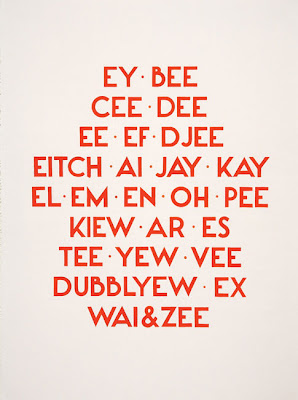
Tauba Auerbach

Tauba Auerbach, ‘How to Spell the Alphabet’

Tauba Auerbach, “How To Spell the Alphabet”
Ink and pencil on paper, 30 × 22, 2005
(via Staple Design)

Susan Rothenberg, Bruce Nauman

Susan Rothenberg describes the blend of studio time and ranch work that she shares with her husband, the artist Bruce Nauman, at their New Mexico home.

Wesley Miller, “Susan Rothenberg: Bruce & the Studio
art:21 blog, May 7, 02010